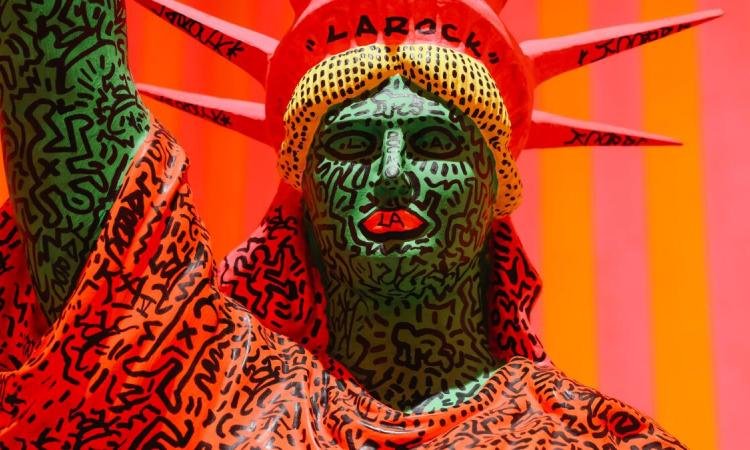
Modern and contemporary art has often been criticized for lacking contact with the general public and for being elitist through hermeticism. Did Paul Klee not declare: “What we will always miss is the Earth and the people...” Keith Haring disagrees with such a charge; his painting and drawing have touched a wide global audience. Religion, current mythologies, AIDS, the fall of the Berlin Wall, dolphin language, hip-hop and the body of Grace Jones, the comic strip, all interest him. He gives brilliant images of them. In Silence = Death (1989), he stacks several signs to draw attention to AIDS:
- The pink triangle carried by homosexuals in the Nazi camps,
- The traditional picture of closed eyes-ears-mouth,
- A swarming of viral contiguity: AIDS.
His public murals count in the dozens. His territory is essentially urban. Keith does not impose himself as a lesson giver or possessor of meaning. He has no theoretical discourse, leaving the viewers of his works to comment on them. But he knows what he does: “I painted on vinyl tarpaulins to not feel the weight of five centuries of paint...” He even created his own art shop on Lafayette Street in New York, from which various derivatives sprang up. Warhol had paved the way and Keith Haring is his direct heir. He is the child of pop art and comics of the 1960s. Now, between 1960 and 1980, a new breed of creators occupied the scene: commercial artists, resolutely media-oriented and communicators. We knew the music of varieties; here is the painting of varieties. Jeff Koons will follow closely. But all this, which delighted the general public, made the contemporary art scene extremely critical of Keith Haring. Do we have the right to entertain people, to be understood immediately by a multitude and at the same time to try the language of painting?Now Keith Haring is a great graphic experimenter, a primitive and modern painter worthy of Klee, Matisse, or Miró (whom he venerated). His drawing does not reproduce anything, never imitates current events: he invents himself. It is a graph whose black line, thick and fluid, solid and flexible, is like a cable tracing the path of appearance of the images. We think of the pre-Columbian ceramics or shields of Oceania, which Keith knew very well. It's unstoppable like an ad in Times Square. Luminescent like neon. New as the digital image on a computer screen. “A real artist,” Haring says, “is a vehicle for the things that go through him.” Keith Haring's art is happening. He declared that he was aware of the state of total improvisation he was in, and never painted without resorting to musical recordings. We might have seen him face a wall of 200 m2 without the help of any preliminary sketch. Not even markers on the surface to be covered. And never any real repentance!