

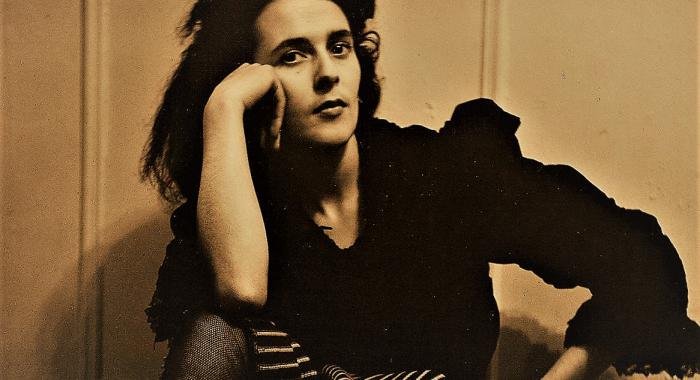
Cézanne revisited Poussin; Hockney reveres Bonnard, as does Warhol; Barnett Newman had a devotion to Uccello—and let’s not even get started on Picasso! It is Sherman’s insatiable appetite for evoking the classics (Ingres, Velázquez, the Etruscans, African art, etc.) that most closely resembles her journeys through her imaginary museum. She has explored the entire spectrum of Western painting! And for her, it’s not a matter of quoting or copying the masters of tradition and their masterpieces. Let’s leave that to the new academicism of the postmodernists. Sherman reimagines ancient art as subtly as she transforms herself.
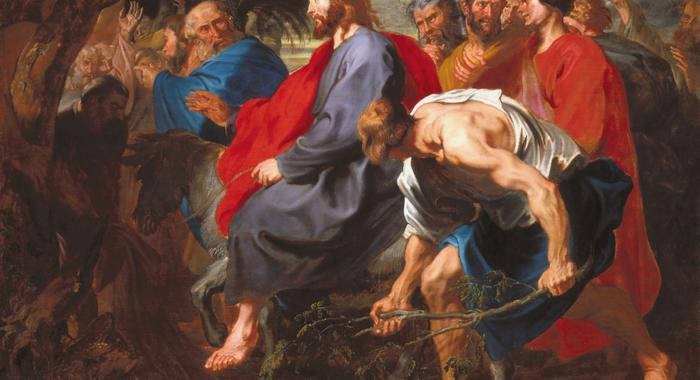
Transformed into characters by Gozzoli, Lippi, Masaccio, Caravaggio, Van Dyck, Bouts, Fouquet, Dürer, and others, Cindy Sherman subverts photography, disorients it, amplifies it, and makes it more complex. It’s impossible to look at these works the way one would look at a simple photograph. These are stunning hybridizations, such as Fouquet’s Virgin with her breast exposed (Untitled No. 216, 1989). In it, Cindy Sherman disguises herself, blending real prosthetics, a photographic image, and her masked body. She needs art history to appear and disappear.
Every great artist revisits the masters. The amnesia of the tabula rasa is a formidable enemy of our modernity. Sherman resolutely rejects this and is not content with postmodern quotations. What she shows, she inhabits. Whatever she evokes, she embodies it. Each time, the masterpiece of the past is cleverly betrayed. Just as the mirror was Cindy Sherman’s enemy, so too does a pious reenactment—in the style of the Grévin Museum—seem abhorrent to her. The viewer’s eye must judge the scene for what it is: a patchwork. We never stop disguising, translating, and betraying. The past as such does not exist any more than the solitary, sincere self. Sherman is a formidable transhistorical theater troupe all on her own.
Cindy Sherman has done everything she can to escape the inescapable nature of the photographic record. Indeed, a photograph is nothing more than an imprint of photons, a ghostly and indirect proof (It’s him! He was there...) of the visible. But it lacks the miraculous power of painting, which consists of moving from the direct recording of a figure or a scene to its trans-temporal transposition through the act of line and color. Cindy Sherman’s reference to the masters of classical painting can thus be explained by her desire to escape a shot that would, in a single instant, amount to a killing. Photograph or painting? Cindy Sherman herself suggests that she is, in fact, creating happenings. Indeed, each of her works presents itself as a small theatrical piece, a curtain rising on a “still.” Be careful—it might move; it has just been set in place; it is no longer moving. The genius of a truly great actor lies in being present, in remaining still while trembling imperceptibly, and in holding one’s breath perfectly. Cindy Sherman’s work involves precisely this kind of theater—a performance, a suspended moment. Curiously, she is not content with the absolute austerity of the minimalists.



 [field_gallery_format]
 [field_gallery_format]