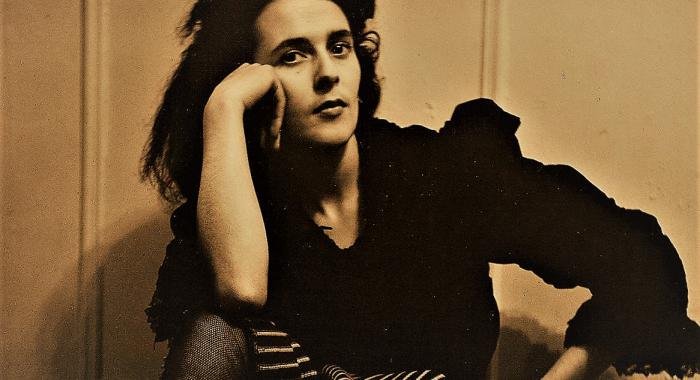

Born in 1929, Yayoi Kusama first made a name for herself on the stage of the New York underground of the 1970s, investing in the fields of performance and fashion, before becoming the world star known especially for its immersive installations with high hallucinogenic potential, populated with peas, soft phallic forms or light diodes - and some of which are to be tested at the Beyeler Foundation, which devoted a retrospective to the artist until January 25, 2026. At eighty-five, this Japanese woman, who has lived in a psychiatric asylum since the late seventies, exhibits everywhere in the West, inspires fashion and collaborates for Louis Vuitton with Marc Jacobs. Her work is now among the most famous in the world.
Yayoi Kusama pretends to be crazy, while she gets bored. Or the opposite. We no longer know. What is certain is that she has been painting peas for sixty years. Madness, passionately and forever. To the end, she says. Since, as she repeats in her rare interviews, "I am a pea, you are a pea, we are a pea lost in the midst of an infinity of peas. The universe is a pea. " And Yayoi has a grain.
For sixty years, she has been reinventing herself with insane coherence: painting, sculpture, writing, photography, video, performance, with always, as points of connection, her polka dots. His writing. She has gone through pop art, minimal, group ZÉRO, monochrome, action painting. She met beatnik Allen Ginsberg, expressionists Mark Rothko and Barnett Newman, performer Yves Klein, minimalist Frank Stella. She had a long platonic relationship with the artist Donald Judd, got confused with Andy Warhol and killed sculptor Joseph Cornell with love. "It was of all excesses, of all contradictions," explains Franck Gautherot, co-director of the Consortium in Dijon and of the Presses du Réel editions. "Avant-garde artists, Greenwich Village hippie, gay gay, partouze organizer, mackerel mother of young ephebs"
Today, it is everywhere and nowhere at the same time. In Vuitton scarves, Toshiba phones or Smarties boxes; in museums and concept stores in Beijing or New York; in its founding in Tokyo. Dispersed, exploded, scattered, unidentified artistic object, impermeable to genres, styles, but imbued with the air of time with finesse and a sense of profit. Not so crazy, deep down. Perhaps she finally managed to tame the obsessions that haunt her since the day when, as a child, she saw the red flower patterns on the table table of the dining room cover her plate, climb along the chairs, walls, before covering her entire body. This hallucination, followed by many others, will inspire him the absolute theme of his work, Self Obliteration, literally "self-erasure." Haunted by this vision, Yayoi Kusama will make whole series where she poses naked, the hail body of peas, melted in her environment, like so many rituals conjuratory to her obsession with disappearance.
Yayoi wants to be a muse, but Yayoi is exhausted: punk before the hour, she ends up annoying Puritan America of the sixties and irritating the avant-garde artists of the time with her forceful merchandising.
Marginalized, she returned to her native Japan in 1973 where she tried to die. Interned at her request in 1977, the artist continues to produce in her studio, near the psychiatric hospital where she lives permanently. In the 1990s, it went through a darker period, accumulating heterogeneous collages and threatening tentacles. She frantically paints hundreds of paintings in a final colourful series: flowers, eyes, mouths without face, then faces without mouth or eyes, and fragments of the latter. The face burst into infinite giclures. Sometimes comes a hand, the silhouette of a little girl, a dog, a renunciation. Dissolved in space, scattered, the memory of Kusama, his obsessions, exorcised in the repetition of the same gesture, of the same color. Her mandalas to her. When we come out of an exhibition of Kusama, the eyes sting like when we have too fixed the sun and send back on all things a round and red spot.
That's pretty much what happened to us during our last stay in New York. A 50-metre long line pointed to an exceptional exhibition in Chelsea, Yayoi Kusama.