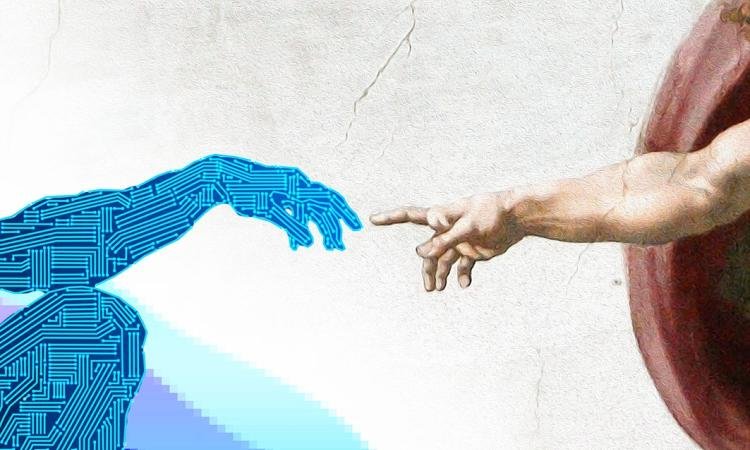
The arrival of AI in the art world is opening up new perspectives for the creation, conservation and marketing of artistic works. Revolution or simple evolution of artistic practices? Artificial intelligence (AI) is rapidly transforming the art landscape, raising questions about the nature of creativity and artistic expression. From algorithms generating original works to tools for predictive analysis of the art market, it interferes in all facets of the creation and dissemination of works. The success of the works generated by AI is carried by cryptocurrencies and NFT (non-fungible token). They pave the way for a new, completely dematerialized art market.
What is artificial intelligence applied to art?
Understanding the evolution of this technology is essential to grasp its impact, more or less positive, on cultural and creative industries.
Definition and key concepts of AI applied to art: what is AI art?
AI applied to art includes the use of techniques to create, analyse or disseminate artistic works. Machine learning allows systems to learn from vast sets of artistic data. Artificial neural networks, including GAN (Generative Adversarial Networks) such as Vanilla, GAN, Or GAN, are capable of generating new images from existing examples. Generative algorithms, on the other hand, can produce original works by combining and transforming learned elements. All these technologies allow machines to analyze artistic styles, generate new works and assist artists in their creative process.
The first artistic experiences with AI
The pioneers of digital art began exploring the possibilities of AI in the 1960s.
Harold Cohen (1928 - 2016)
British artist Harold Cohen was one of the pioneers of digital art. Initially an abstract painter, he became interested in computer science in the late 1960s, seeking to explore the creative potential of machines. Its Aaron programme, initiated in the early 1970s, has become a historical reference in this field. Aaron is a computer system designed to generate drawings and paintings without direct human intervention, following artistic rules of composition, shapes and colors elaborated and coded by its creator. The latter has continuously enriched it, passing from simple black and white plots to color compositions. Aaron did not copy existing works, but produced original works. In this Harold Cohen was not only a user of computer tools, but a true "meta-creator" who designed the frames allowing the machine to express its own creativity. His work questions the boundary between human and machine, and has opened a dialogue of a new nature. Aaron has been exhibited in prestigious museums such as the Tate Gallery in London or the Computer History Museum in Moutain View, California, in the heart of Silicon Valley.
A.Michael Noll
Between 1962 and 1965, American engineer and professor A. Michael Noll created some of the first computer-generated images. In the summer of 1962, while working at Bell Telephone Laboratories in New Jersey, he used an IBM 7090 computer to plot mathematical patterns, translated into images. Precisely, he programmed this computer to generate abstract artistic patterns, visual images from random processes and mathematical instructions. This approach, similar to that of research figures such as Frieder Nake and Georg Ness in Europe, makes Noll one of the first people to produce images formed by computer algorithms.
His works are inspired by leading artists of abstraction, such as Mondrian. Among his most famous creations, Gaussian-Quadratic (1962-63), consists of 99 lines connecting 100 points, with horizontal coordinates distributed according to a Gaussian law (a mathematical model that describes how certain values are distributed around an average) and vertical coordinates according to a quadratic equation (mathematical equation in which the variable is squared). Noll's productions, widely recognized as a pioneer of digital art, were publicly exhibited in 1965 at the Howard Wise Gallery in New York.
Vera Molnár (1924 - 2023)
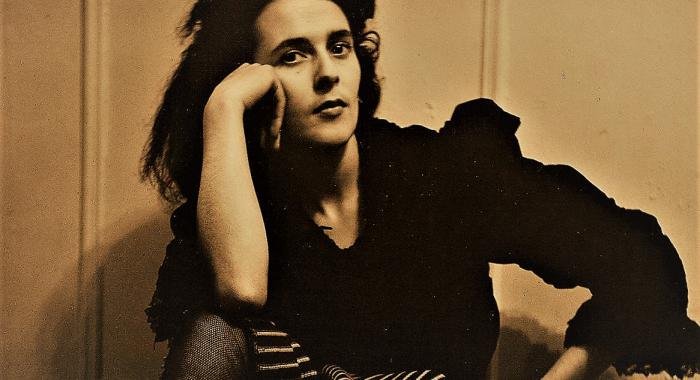
The French visual artist of Hungarian origin, Vera Molnár, is considered one of the pioneers of digital art and algorithmic art. In the late 1960s, she designed programs to generate abstract geometric compositions, combining mathematical rigour and artistic sensitivity. In particular, she uses a tracing table to produce her works. His work explores seriality, geometry and the introduction of chance into the creative process, the balance between order and disorder, repetition and variation, often from simple forms such as square or straight line. Before integrating the computer into her artistic practice, she imagined protocols and "imaginary machines" that consist of manually developing generative processes and then translating them into computer instructions.
She developed her "imaginary machine" in 1959, and participated more widely in the development of generative art in Europe, through the Group Art et Informatique which she co-founded in 1967 at the Institute of Aesthetics and Art Sciences. As early as 1968, she became one of the first artists to make the computer a central creative tool, developing written programs to automatically generate works from selected parameters. Throughout her career, she claims the importance of human sensitivity behind the use of algorithms. Until the end of her life, she continued to explore the possibilities offered by technology, experimenting with artificial intelligence and NFT. It has thus paved the way for a whole generation of artists who today use code, algorithms and AI as a creative medium. These early experiments laid the foundation for generative art, which uses algorithms to create a work autonomously.
How does AI influence different artistic disciplines?
The impact of AI is felt in all forms of artistic expression, from painting to music to literature and cinema.
Impacts on the visual arts: painting, drawing, sculpture
Software such as DALL-E 2, Midjourney or Stable Diffusion generate images from textual descriptions, such as for example a Picasso style table depicting a spationaut dog, in a few seconds, from a request "create a Picasso style table with a spationaut dog." These tools offer artists new sources of inspiration. The new artist profiles, the "ia art maker," emerge thanks to these tools. If you're wondering what AI is called for in drawing, to make contemporary art in artificial intelligence... you will have the embarrassment of choice!
The Portrait of Edmond de Belamy d'Obvious, sold at Christie's for $432,500 in 2018, marked the entry of generative art into the traditional market. It was produced by a computer program. The algebraic formula used is written in the lower right corner of the table.
In sculpture, artists like Ben Snell use AI to design complex shapes, then made by 3D printing or CNC machining (subtractive manufacturing). The AI also allows to analyze and reproduce the style of famous artists, such as the project The Next Rembrandt, which allowed to create a new work in the style of the Dutch master.
How does AI redefine musical composition, mixing?
In music, AI transforms creation, but also production. Platforms like Aiva can compose whole songs in various musical styles. Huawei completed Schubert's unfinished symphony using machine learning. The iZotope's Neutron 4 tool uses AI to optimize mixing and mastering, to analyze audio tracks, or to suggest adjustments. AI also helps with the restoration of old recordings, such as the Zenph Studios project. Within this program, performances by legendary pianists, such as Horowitz, have been recreated from old recordings.
AI at the service of literary creation, writers
GPT-5 and its derivatives can generate consistent texts on various topics, helping to overcome whitepaper syndrome. Ross Goodwin's novel 1 the Road was written entirely by an AI during a car trip. The algorithm was trained to write by analyzing 200 works of English literature. Software such as Sudowrite thus assists writers by suggesting descriptions, dialogues or plot developments. AI is also used to analyze narrative structures, writing styles, as in the Bestseller Code project, which attempts to predict the commercial success of books.
Cinema and animation: screenplay, visual effects assisted by AI
The film industry is rapidly adopting AI. Book uses this technology to analyze scenarios. AI tools, like Adobe Premiere Pro, automate certain aspects of post-production, such as rotoscoping or composition. Artificial intelligence helps interpolation between key images, reducing the time needed to animate characters.
Oscar Sharp's short film Zone Out was entirely written and edited by an artificial intelligence named Benjamin. It illustrates the possibilities, but also the current limitations, of AI-assisted film creation. According to Cinébulletin, this short film is a "poorly dubbed parody based on swap face (or face change)."
AI, an innovation tool at the service of the artistic experience
Beyond creation, AI transforms the way we discover, appreciate, preserve art.
AI, personalized artistic recommendations
Spotify uses AI-based recommendation algorithms to create custom playlists like Discover Weekly. Online galleries like Artsy use this technology to suggest works to collectors, based on their preferences, their purchase history. By offering ever more relevant recommendations, they greatly increase the satisfaction of their users, which increases their loyalty.
Creation of works of art by algorithms
Generative art is gaining recognition. Artist Refik Anadol uses deep learning algorithms to create sculptural, immersive data installations. This technology relies on sets of neurons called networks. The French Artrendex platform uses AI to analyze trends in the art market, predicting emerging artists.
AI to protect, preserve art: authentication, preservation
Art Recognition uses AI to detect forgeries, authenticate works of art. The Louvre Museum uses this technology to optimize the conservation conditions of its works, analyzing environmental data, predicting potential risks. For example: temperature variations, vibrations or air pollution.
AI to redefine art: immersive, interactive experiences
Refik Anadol's Machine Hallucinations installation at the Pompidou Centre uses AI to create ever-changing visualizations. The AI: More than Human project at the Barbican Art Gallery in London presented a series of interactive installations exploring the relationship between AI and creativity. Jumbo Mana allows art lovers to exchange with Arthur Rimbaud or Van Gogh at the Musée d'Orsay. The French startup Artmyn uses artificial intelligence to create immersive experiences of works of art. They allow users to explore tables in high resolution, under different lights.
AI at the service of galleries and collectors: analysis of trends in the art market
Wondeur uses machine learning to predict the career trajectory of artists, the future value of their works. Artnet uses AI to provide insights into market trends, helping collectors and galleries in their buying and selling decisions.
How AI revolutionizes cultural mediation
Cultural mediation is undergoing a profound transformation thanks to artificial intelligence tools. Museums and institutions seize it to offer enriched experiences. Cultural chatbots such as Ask Mona or the interactive voice of Rmn-Grand Palais allow visitors to interact with the works, obtain contextualized explanations, and deepen their understanding.
Some exhibitions rely on augmented reality coupled with AI to offer personalized tours, according to the preferences of each visitor. This paves the way for the democratization of culture by making content accessible, dynamic and interactive.
The future of art in the era of AI: what prospects?
The growing integration of generative AI into the art world raises questions about the future of creativity, authenticity, artistic value.
Creation of generative works of art
More sophisticated algorithms will allow greater diversity and complexity in the works generated by AI. Collaboration between human artists and artificial intelligence is becoming more fluid, intuitive, with tools like Google's magenta project. A project that explores new interfaces for art creation assisted by AI.
Artists in residence: a new form of collaboration
More and more art institutions are welcoming artificial intelligences as "residents." This is the case with the Barbican Centre in London or the PHI Centre in Montreal. These structures integrate AI into creative cycles or exploratory exhibitions. The idea: to consider AI no longer as a simple tool, but as an entity with which to dialogue and experiment. This approach raises new questions: how to co-build with a machine? Who signs the final work? Which look at a creation resulting from a human-algorithm cohabitation?
New art forms: collaboration between artists and AI?
Artists like Sougwen Chung, who works with AI-controlled robotic arms, show the potential for physical collaboration between humans and machines. Robbie Barrat's AI-Generated Nude Portraits explores the biases and limitations of AI in the representation of the human body.
AI tools at the service of artists
Virtual assistants specializing in different art forms help artists at all stages of their work. For example:
• by offering them colour palettes, compositions or techniques adapted to their stylistic preferences;
• by providing them with suggestions for improvement, comparisons with other works or aesthetic evaluations.
Inter-media artistic translation tools allow to automatically transpose a painting into music or a poem into sculpture.
Evolution of crafts with AI
New roles are emerging, such as "AI curators" specializing in the selection, exhibition of works generated by AI. "Artist-programmers" mastering both art and AI programming are increasingly sought after. The same applies to "digital art dealers," specialised in the sale and promotion of artworks generated by AI.
Ethical challenges and copyright: who is the real author?
The legal definition of the author will have to be rethought for works created in collaboration with AI. Debates on the intellectual property of training data used by artistic AI will certainly take place. The question of authenticity, the value of the works generated by AI will continue to be debated in the art world.
FAQ on AI in art
How can AI be programmed to create art?
AI is programmed to create art through deep learning algorithms. They analyze large quantities of existing works. These algorithms learn patterns, styles, techniques, and then use them to generate new creations.
What does the notion of copyright on a work created with AI mean?
In many countries, copyright is attributed to humans who have used AI as a tool. However, this approach could evolve with the increasing sophistication of artificial intelligence systems.
What role do data play in AI's artistic creation?
The more diverse the training data, the more AI is able to create interesting works. Their quality directly influences the creativity and originality of AI's responses (outputs).
Can AI really be considered as an art creator?
This issue is the subject of much debate. For some, AI only reproduces, combines what it has learned, without real "creativity." Others consider his ability to generate unique, sometimes surprising works to be a form of creativity.
What is an artificial intelligence drawing generator?
A drawing generator based on artificial intelligence is a computer tool capable of creating images from data. It relies on the analysis of thousands of existing illustrations to learn how to reproduce shapes, styles or visual atmospheres. These AI are now used to design original artistic works or to accompany image professionals in their graphic production.
What are the main image-generating AI?
Among the best known tools, DALL· E (developed by OpenAI) transforms a textual description into an image. It is widely used to create original, realistic or imaginary visuals.
MyEdit, for its part, is an online image and drawing generator offering the free creation of content from a descriptive text in French. Stable Diffusion, an open source solution, is appreciated for its flexibility. It makes it possible to create various styles, from sketches to digital painting.
Leonardo AI has been designed for creative people: its user-friendly interface seduces professionals in video games, fashion and illustration.
Finally, Adobe Firefly, integrated in Photoshop and Illustrator, allows to generate or modify images directly from texts or layers. It is aimed at professionals of visual creation.