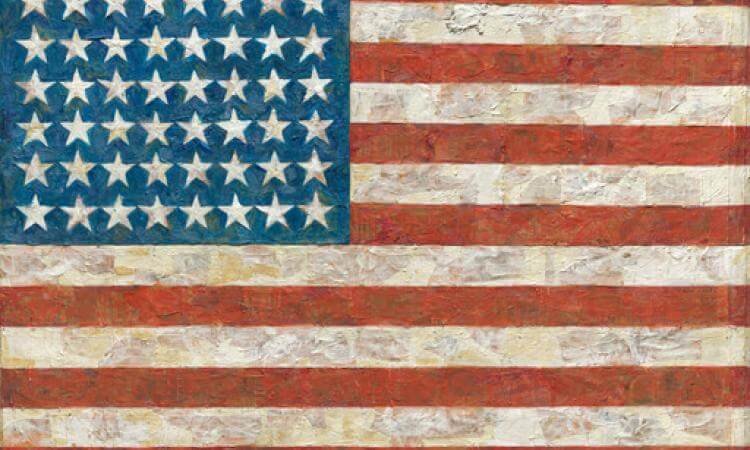
Flag, 1954–1955
A masterpiece by Jasper Johns, this encaustic painting (one of his favorite techniques) inaugurates a long series that the artist dedicates to the American flag. This canvas questions, with a form of radicality, the very idea of a symbol of a nation. It also raises the question of the relationship between the real and its double. Johns's flag has a political dimension, being painted at the beginning of the Cold War. The artist continues this series in the 1960s, at the height of the Vietnam War.
Painted Bronze (Savarin Can with Brushes), 1960
%2C%201960%20by%20Jasper%20Johns.jpg "Painted Bronze (Savarin Can with Brushes), 1960")
Created from an assembly of a coffee box and a set of used brushes, this sculpture belongs as much to the history of neo-Dadaism as to pop art. On the one hand, Painted Bronze has only the appearance of a ready-made because it is indeed a bronze sculpture painted by the artist and not a manufactured object. On the other hand, Johns draws here from the universe of everyday life, from the ordinary, questioning the boundary between reality and its representation.
Target with Four Faces, 1955
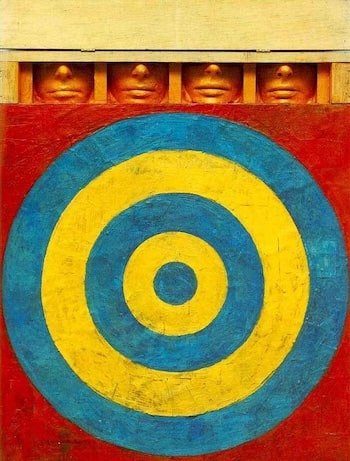 The shooting target is another iconic pattern of Jasper Johns' work in the 1950s, which positions him as a neo-Dadaist figure. Here is another theme that is in touch with the symbolic imaginary of war, hunting, but also terribly plastic and haptic. Looking, the eye is aiming; even though the mouldings of faces embedded in the painting are deprived of sight. Johns's works are always more complex than they seem. Simplicity, at home, is always misleading.