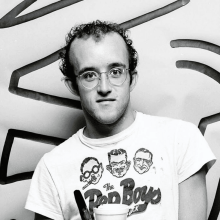
Born in 1958 in Kutztown, Pennsylvania, Keith Haring died of AIDS in 1990 in New York City. Like his friend Basquiat, he built in less than ten years a body of work with great media impact. Haring moved to downtown New York City at the age of 19 and attended the School of Visual Arts in New York; his work bears a strong Pop Art style. He studied advertising and became familiar with conceptual art at the School of Visual Arts, before being noticed for his first tagger interventions in the New York subway in 1980. He was an American artist whose style of painting is recognizable by its clear lines and space. He also worked without models or sketches throughout his career. He drew some of his methods from the graffiti scene. Haring is considered a representative of Pop Art of the 1980s and one of the greatest Street Art artists of all time. As an artist of the Neo-Pop movement, active in the 1980s, he quickly distinguished himself from traditional painting, and his work was characterized by its simplicity and immediacy, often staging repetitive motifs and images close to the comic strip. Schematic figures, babies, dogs, flying saucers, televisions, and geometric shapes were frequently featured in his creations. While he initially limited his palette to the three primary colors, he later expanded his chromatic range while continuing to favor fundamental shades.
Haring began his career as a street graffiti artist, using electric poles, concrete pillars, billboards, and signage as supports, and using all the tools within his reach, from pencil to aerosol spray to brush. His sculptures were characterized by a wide variety of materials, ranging from papier-mâché to fiberglass. In addition, he designed numerous posters and also ventured into the field of artistic performance. His earliest works were created around 1980, when he would search for blank spaces on black posters in New York City subway stations and doodle on them with white chalk, mostly consisting of bold outlines and monochromatic, hollow abstract figures of people, animals, and other motifs. His works often resemble intricate patterns, with various motifs filling the entire composition; they typically lack perspective or realistic texture but feature many symbolic scenes, such as barking dogs and small figures kneeling or lying prone.
In a short time, Keith Haring’s work gained fame in the New York art scene. In 1983, a CBS News report featuring him creating graffiti in a subway station, along with footage of his arrest, made him a household name overnight. Subsequently, through a steady stream of exhibitions and new works, he gained entry into museums as a graffiti artist, and the prices of his works skyrocketed. According to a report in Newsweek, in 1984, one of Keith Haring’s paintings, “Dog with an Alligator Mask”, fetched as much as $20,000. In addition, he was invited to create many site-specific works for museums. In 1985, the Musée National d’Art Contemporain in France and the Rijksmuseum in the Netherlands held solo exhibitions dedicated to him. In 1986, he opened a general store in New York’s SoHo neighborhood called “Pop Shop” to sell his own artwork.
In 1988, after learning he had AIDS, Keith began actively using his art to remind young people about safe sex and to participate in campaigns to prevent the spread of AIDS. In 1989, the Keith Haring Foundation was established, with the primary goals of supporting AIDS treatment research and promoting children’s welfare programs. In 1990, Haring died in New York from complications related to AIDS at the age of 31. His paintings have become one of the most striking representations of 20th-century visual art.
There is currently no content classified with this term.