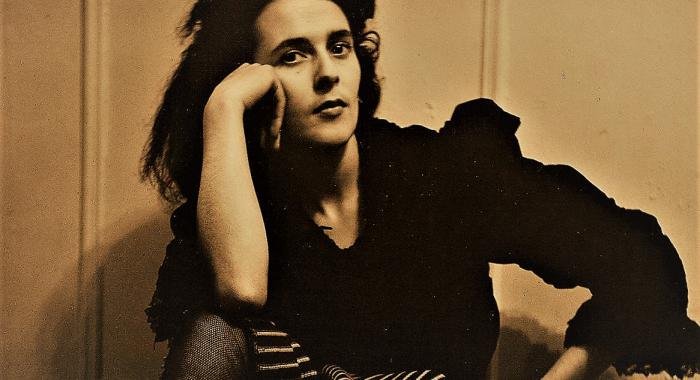
The young German, born on June 25 1884 in Mannheim, in a family of bankers, had discovered the painting at the Karlsruhe Museum. Passionate about art, he grew up in 1903 with Cézanne and the wild beasts. In early 1907, his uncle, a brilliant businessman, planned to send Daniel-Henry to South Africa to defend his interests. He declines the proposal, because his ambition is to be part of the art world.
The lightning stroke was Paris, the Autumn Salon, Derain, Vlaminck, Van Dongen, the first Braque. In 1907, he abandoned the stock exchange: he was twenty-three years old and, although the trade of painting merchant was not a young man's trade at the time, he decided to open a gallery rue Vignon.
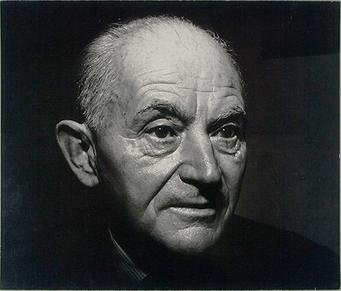
And it was there that, again in 1907, he saw Picasso enter, accompanied by another German, Wilhelm Uhde, also a great amateur and merchant in his own time, whose career would be parallel to his own.
On his advice, he visits Picasso at the beginning of the summer to see Les Demoiselles d'Avignon. At first glance, he understands that they open a new era of painting. The next day, they meet again and never leave.
Thanks to Picasso, Kahnweiler will meet Max Jacob, Apollinaire, whose art critics he particularly appreciates, Salmon, Reverdy, Maurice Raynal, Manolo. Then, in 1910 or 1911, at the time of the Nus in the forest, Fernand Léger and, finally, Juan Gris, who was one of his best friends and the painter to whom he felt probably the closest.
Following the example of Durand-Ruel and Vollard, who were models of insight and courage for him, he is convinced that we must discover new talents and acquire their works as soon as possible. He became the first permanent defender of Picasso and then of the great cubists - notably Juan Gris.
For Kahnweiler, a gallery must be a community of spirit and interest bringing together around a merchant a few artists, provided with a strong and true enough originality to attract collectors and traders.
When the First World War came, Kahnweiler was in Rome, with his wife and, like Uhde, like so many others, he saw the drama of all men of dual national and cultural belonging.
His commercial and artistic activity interrupted, Kahnweiler occupied his years of retirement forced to read, to write, acquired a solid philosophical culture. But when he returned to Paris in 1920, it was almost ruin.
With his usual tenacity, Kahnweiler returned to work, opened a second gallery, rue d'Astorg (Simon Gallery), bought some paintings, and in the crazy years leading up to the first "boom" of modern painting, he seemed on the verge of approaching happier shores, when 1929 came.
The crisis ruined some merchants, imposed very difficult living conditions on most painters and literally suppressed the market. "We didn't sell anything anymore. I had with me my sister-in-law Louise Leiris who had entered the gallery in 1920. We were alone. Before, we had a racing boy that I had to send back. We were in this gallery alone for whole days; nobody was seen. We were there. "
The many works devoted to the great merchant have spoken of the difficulties of the interwar period: the sales of his goods, the sarcasms which accompanied them, and then the crisis of 29 which deprived the new Simon gallery, rue d'Astorg, of its buyers and even of its visitors. Nothing, however, interfered with Kahnweiler's determination and faith. If his decisive choices, those to which his name remains definitively attached, date from before the first world war, it was after the Second World War that art triumphed whose novelty he had discovered so early.
My galleries and painters, such is the title of the Interviews with Francis Crémieux broadcast from May to June 1960 on the radio.
My painters, what a possessive! Having known personally neither Kahnweiler nor most of his "" painters, I do not know how far one went on both sides in possession. But what I can say, having experienced it myself, is that these relations of master/slave possession, each being the master and the slave of the other, are, in the world of art, normal, indispensable and much healthier than one might think.
What Kahnweiler has of example is not only due to his successes, to his ability to impose himself, to the clarity of his convictions. What moved us today was that he was able to recognize as a contemporary what was to appear later as the best of his time. What the young man of barely twenty could choose from the fatras of the time - Picasso, Braque, Léger, Juan Gris, Derain - corresponds to what art history came to endorse afterwards. Kahnweiler, convinced of the correctness of his choice and his truth, was largely supported by the verdicts of history. Such a brilliant premonition cannot be a mere coincidence. Such was this great merchant, whom one of his confreres, Louis Carré, avaricious of compliments, named "our prince."
There is currently no content classified with this term.