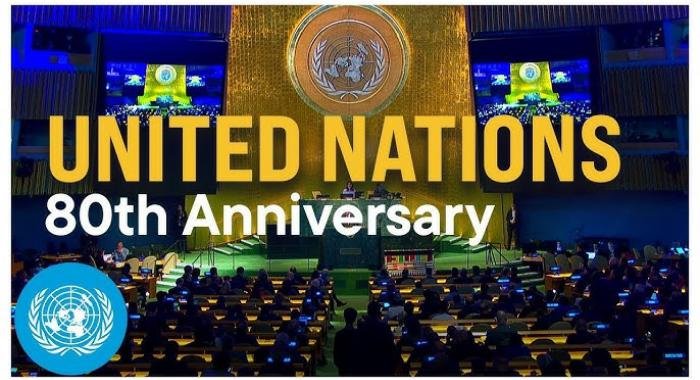
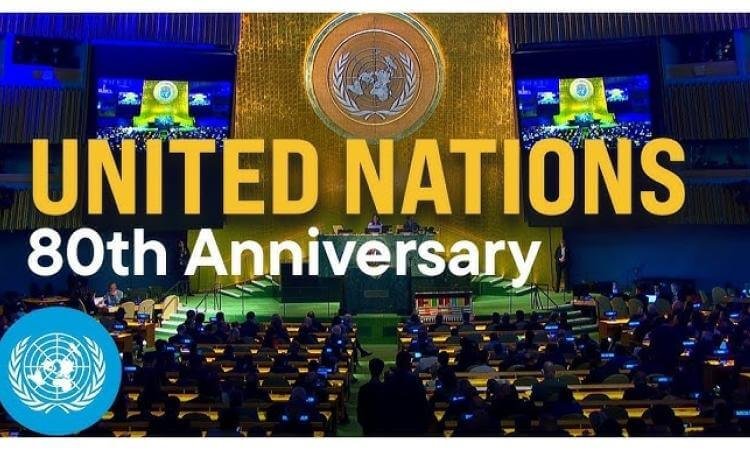
This year the UN celebrates its 80th anniversary. By promoting peace, human rights and social progress, including access to healthcare and education, the United Nations has improved the lives of people around the world, creating better living conditions for all. "Eight decades later, a direct link can be established between the creation of the United Nations and the prevention of a third world war," said António Guterres, Secretary-General of the United Nations. But is that really true? What is the true Financial Survival cost of Global Peace in the time of the "Imminent Financial Collapse" of this organisation and the Current World Events after the Russian-Ukrain war. What was the role of the UN's role in the Gaza reconstruction efforts, the "Donroe Doctrine" influence on global security, and the Pact for the Future adopted in late 2024 ? So why the united nations organisation was established ?
Why and when was the united nations organisation established ?
The priority task was to end the war in Asia and to ensure the foundations of peace. As soon as he came to power, Truman began by questioning Byrnes about what had been said in Yalta and understood that negotiations with the Soviets would not be easy. Roosevelt carried in his grave state secrets or left many ambiguities. What will become of Poland? And the other states occupied by the Red Army? At least on one point there are grounds for hope. Like Roosevelt, Truman wants to found a United Nations Organization that, with auxiliary agencies, will deal with and perhaps solve major international problems. On April 25, 1945, in San Francisco, amid the half-mast flags reminiscent of Roosevelt's recent death, the inaugural UN conference opened. Forty-six nations, then fifty sent delegates. The American delegation, formed in February, includes Republicans, such as Senator Vandenberg and his senior adviser, John Foster Dulles, and Democrats. It is led by Stettinius. The drafting of the charter requires lengthy negotiations. The four Major States (United States, Soviet Union, Great Britain, China) agreed on a text that amended the Dumbarton Oaks proposals. It is the Yalta formula that is adopted. The Security Council will comprise eleven members, of which the four Major plus France will occupy permanent seats. It will take its decisions by a majority of seven votes, provided that, apart from procedural discussions, the decision is based on "the convergent vote of the permanent members." One of the five Great can still block the functioning of the Council. In plenary, the Soviets ask for more: a Great could block the discussion of any issue by the Council. Protests by the United States, followed by other conference participants. The Soviets retreated, on the understanding that the right of veto would apply to important problems, "taking into account the primary responsibilities of the permanent members." The fate of dependent nations is regulated by the trusteeship formula. As for the regional pacts (the Soviets wanted to dissolve the pacts between the states of the American continent), they are allowed if they are placed under the auspices of the United Nations. On June 26, the charter was signed in the presence of Truman. It is, says the president, the affirmation of "the conviction that war is not inevitable."
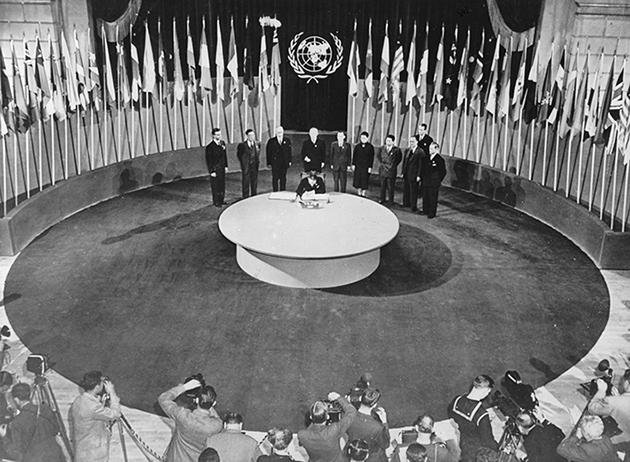 This time, unlike the post-First World War, the United States Senate gave its approval. It is true that Roosevelt took the necessary steps to prepare a decision which, in his view, can only be that of all Americans. Arthur Vandenberg, the Republican Senator from Michigan, loudly supported the idea of a policy of global responsibility. If there are isolationists in the Senate who cry out at the communist conspiracy and see in the charter a document "atheistic and unconstitutional," they are very few. And cautious: a survey indicates that 66% of Americans approve the charter, 3% disapprove of it and 31% do not vote. The Senate gave its approval by 89 votes to 2, on July 28, 1945. Three months later, the charter was promulgated. The Americans have good reason to rejoice. At the cost of some minor concessions, they got what they wanted. If the United Nations is weakened by the veto power of the Great Ones in the Security Council, they have asked for it. If the regional pacts remain, it is on their insistence. If a network of secondary institutions, to help refugees, discuss labour problems, deal with monetary and financial issues, complete the organizational chart, it is because Washington has demanded it. Moreover, the United States then had what would later be called the "automatic majority" in the General Assembly. Wilson and Roosevelt triumphed posthumously.
Why did the US drop an atomic bomb on hiroshima and Nagasaki ?
The atomic explosions of August do not detract from optimism. Quite the contrary. The two bombs destroying Hiroshima on the 6th and Nagasaki on the 9th have achieved their objectives. On August 14, the Japanese government accepted the terms of an unconditional armistice and Emperor Hiro-Hito informed his subjects the next day. On September 2, aboard the Missouri battleship, anchored in Tokyo Bay, the armistice was signed. This is the end of the Second World War. But the atomic weapon is new, terrifying. It soon provokes anxiety. As early as 1948, a British physicist, P.M.S. Blackett, asked a question on which American historians have questioned themselves at length and have yet to provide definitive answers. Did it take atomic weapons to win the war against Japan? If this was not necessary, what real goals did Truman and his advisers pursue? Did they not seek, by killing thousands of Japanese, to frighten the Soviets, thus to start the cold war? Serious accusation which too often rests on a confused argument.