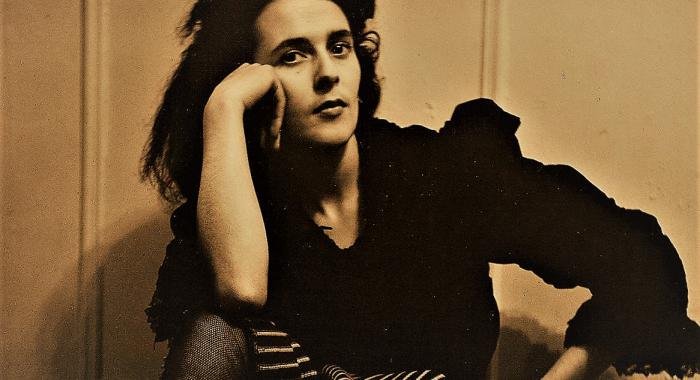
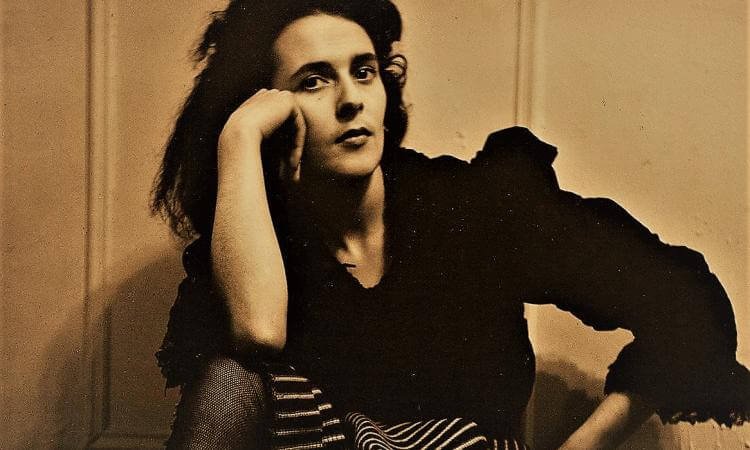
Born in the early 20th century in Lancashire to an industrial textile father and an Irish mother, Leonora Carrington was fascinated from childhood by Irish mythology and fairy tales. It is this fabulous world where half-gods, saints, animals and monsters coexist that visitors find her works in most museums in every corner of the world. The rich little girl of a textile industrialist, born in 1917 in England, lives between 1920 and 1930 in a vast Gothic Revival house, the spirit of mythological tales, fairy tales and Victorian literature. She already draws, makes watercolors, illustrates her dreams. At the age of 15, she attended a school for high society girls in Italy, but began to reject the environment that her parents would like her to integrate. She will tell its story in 1937. Meanwhile, she discovered surrealism with a book offered to her by her mother. She displayed creativity and artistic talent from an early age. At 19, she defied her parents' plans and went to London to study painting, at a newly opened school run by a French Cubist named Amédée Ozenfant. From him she learned everything there was to know about art. He was demanding, but never discouraged his students. They had to understand the chemistry behind their pencils, paints, and paper, and equally master the craft of painting. There she met and fell in love with Max Ernst, who was twice her age, and followed him to Paris, which marked a final break with her family. "Never will my door be darkened by your shadow," her father declared, and promptly cut off her allowance. Her parents considered their daughter's artistic pursuits merely a phase, a brief escapism from which, having come to her senses, she would return to their arms and fit into the predetermined mold. But during that time, Leonora became the white horse in her self-portrait; she had broken free, freed herself from the bridle—her home was now art.
She met the blue-eyed surrealist in the London apartment of mutual friends. It was a warm June evening. They stood facing each other, champagne glasses in hand. The champagne overflowed, Max dipped his finger into his glass, Leonora hers into hers. It was love at first sight. She was 20, he was 46. Leonora and Max were a couple for four years. Initially, they lived in Paris, and from 1937 onward in a secluded stone house in Saint-Martin d'Ardèche, where they created their own paradise. They produced paintings, murals, and sculptures, as well as numerous texts. They also explored magic, astronomy, and alchemy. When her father, Harold Carrington, heard of this relation, he pulled every string to have Max arrested for his allegedly pornographic works. His influential hands reached dangerously from the northwest of the country all the way to London. "Back to his German homeland with that creep!" he thundered, back to a country that now called itself the "Third Reich," where Leonora's lover was already on the list of degenerate artists. Max Ernst had to go. Just as Tartar, Leonora's beloved rocking horse, had to go, as she writes in her short story "The Oval Lady." On September 3, 1939, Great Britain and France declared war on Germany. Max was arrested because he was German. He was interned in the Camp des Milles, the camp established for all "undesirable foreigners" that, under the Vichy regime, became a deportation camp for Jews. The building was a former brickyard, everything inside red with brick dust. Soon, it was also Max's face and Hans Bellmer's. The two artists made portraits of each other, of their furrowed, aged faces behind bars, while Leonora, suddenly alone and terrified, did everything she could to free her lover. She wrote to friends and her mother, begging for money and support. And indeed, in December, Max was allowed to leave. His friend Paul Éluard had persuaded all the important French figures to sign a petition. But their domestic bliss was short-lived. No sooner had Leonora nursed Max back to health than armed police officers appeared at their house and led him away in handcuffs. A deaf-mute man in the village had denounced him, claiming Max had been sending light signals to the enemy. Leonora wept and vomited, desperate to break free from society and its poison. She barely ate anything and did nothing but paint, undeterred even by the Belgian soldiers who threatened her with death. When Max Ernst was repeatedly arrested and interned by the Nazis, it led to a nervous breakdown for Leonora Carrington.
“Every second I want him to live only for me and with me. I wish he had no past. I want him forever. I want to be in the same body as him.” Diary entry by Leonora Carrington, 1939
British artist Catherine Yarrow, seeing her friend in her desolate state, could only plead with her to flee with her and her husband from that nightmarish corner of France. They would be safe in Spain. Leonora knew she had to leave. She knew it even before Max had been taken away. She loved him; he was her savior. He had fed her, guided her, and raised her. But to truly grow up, she also had to leave her second father.She could only achieve her birth as an independent artist without him. Leonora climbs into the back of the tiny Fiat. She can't take all the tokens of love she and Max had created with her, only his passport. The three of them drive to Perpignan and beyond; the Wehrmacht has now breached the Maginot Line. She sees trucks with arms and legs dangling from their beds. Death seems to beckon to her from everywhere. She feels guilty. Letting her rescuer rot in prison. And when he gets out? There's nothing he can return to. No Leonora and no house. She had to sell it to finance her escape.
In Andorra, she gets out of the car and can no longer walk normally. Only sideways, like a crab. It is the beginning of a breakdown. Madrid becomes her, becomes her torment; she sees herself from above, as if she were in chains, and thinks she must liberate the city in order to be healed. Her delusions merge with reality; the boundaries are indistinguishable, even in her short story "Down Below," which she later writes about her psychotic state. Fiction, illusion, reality, and delusion—everything is an inextricable, terrifying labyrinth from which Leonora can no longer find her way out.
Meanwhile, her father, based in Lancashire, had tasked his Dutch business partner, Van Ghent, with looking after his daughter. She wanted to give him Max's passport, but he refused it. "So I'll have to kill him myself!" she cried, and ran into the street. She gave her remaining belongings to some soldiers who dragged her into their car, drove her to a house, and raped her. She was dumped in Retiro Park and picked up by a policeman who took her back to her hotel. She spent the entire night taking cold baths. The next day, she ran into the street again, tore up newspapers, and scattered them, believing them to be hypnosis devices controlled by Van Ghent, her father, the enemy of humanity. She called the British embassy and denounced the Dutchman who was waging hypnosis warfare for Hitler in Spain.
At the instigation of her father, the wandering artist was found in Spain and committed to a psychiatric hospital. In August 1940, two doctors came. They told Leonora she could take a trip to the beautiful lakeside city of San Sebastian to enjoy the sun. Then they gave her an injection. "Like a corpse," they handed her body over to Dr. Louis Morales, Leonora writes in "Down Below." He was the director of Villa Covadonga in Santander, a clinic for the mentally ill, which Leonora always referred to simply as an asylum ("asylum"). She awoke in a tiny, dark room, her body so full of pain that at first she thought she had been in a car accident. These were the after-effects of Luminal, the anesthetic that had incapacitated her. Her parents wanted her to be safely housed. A crack in the door opened onto a corridor. There was a wardrobe, a small table, a chair, and a chamber pot. She lay on a bed, her arms and feet secured with leather straps.
Leonora was a prisoner
Then came the electroshocks. She was given Cardiazol, which triggered a seizure, and from which the doctors hoped for a return to reality. In truth, it could do more harm than good: Besides back injuries, dislocated jaws, and heart attacks, the drug was also capable of erasing memories, increasing depression, or inducing hallucinations.
The "therapies" prevalent at the time—electroshocks and injections of cardiazol—triggered horrific visions, delusions, and a fear of death, from which the doctors hoped for a return to reality. In truth, it could do more harm than good: Besides back injuries, dislocated jaws, and heart attacks, the drug was also capable of erasing memories, increasing depression, or inducing hallucinations. In her text "Down" and the three-act play "The Feast of the Lamb," she describes these gruesome treatments and their consequences."Each of them seized a part of my body, and I saw all their eyes fix on me with a horrific stare. Don Louis's eyes tore my brain apart, and I sank into a well... very deep... The bottom of this well was the stagnation of my mind for all eternity in excruciating agony."
I had cramps, was pathetically ugly, pulled faces, and my faces repeated themselves all over my body. Leonora Carrington in "Down Below"
When she awoke, she was lying on the floor of her room. Broken. Ready to become the slave of the first visitor, ready to die. The rebel had been broken. For several days, she lay there bound, in her own sweat, urine, and feces. Tortured by mosquitoes that mistook her for the crushed Spaniards she hadn't been able to save, mosquitoes that were now punishing her for her lack of intelligence, her submissiveness, and her internment.
The second time, she closed her eyes so she wouldn't have to witness that horrible stare as she slipped into a fit. The third time, she kept them open again. The fighter was back.
But the clinic had taught her something: she could be destroyed.
And while Breton, in his manifesto—which, incidentally, she had never read—theorized about how to normalize madness, Leonora tried not to lose her mind completely in that asylum. To that end, she imbued the few things she owned with magical powers; her face cream, powder, and cologne became totems, alchemical elixirs and antidotes—a survival strategy in a place that had stripped her of all control over her life. Her lipstick represented the encounter with color and language, painting and literature. It represented art, the very essence of her existence, which in those dark weeks shrank to a symbol. Leonora's world had truly become surreal.
Carrington then managed to escape through a sham marriage. In December 1940, she was able to leave the psychiatric hospital with the help of a distant cousin, but her father continued to control her: through a nurse who constantly accompanied her and a business partner who was supposed to take her to Lisbon and from there transfer her to a sanatorium in South Africa. As a way out, he offered her an apartment—in exchange for sexual favors. Leonara said no.
Her salvation came in the form of a handsome Mexican poet. Renato Leduc was an old friend of Picasso, and he offered her freedom—an escape from her father's clutches. Leonora accepted. First to New York and later to Mexico, where she was active in the women's movement, among other things, until she died in Mexico City at the age of 94. Leonara would shower fully clothed or rub mustard on her feet in a chic restaurant. She performed before there was a name for it. Her true home was the border. The in-between space where reality and imagination met, where magic and the everyday mingled. In Mexico, she would succeed in creating a home that resonated with her innermost self. At the end of 1942, she left first the USA and then Renato, with whom she had lost all contact. She moved in with Remedios Varo, a Spanish painter she knew from her time in Paris. The house, located in the heart of old Mexico City, was dilapidated, rats lived in its holes, but that didn't matter: it was a magical place full of talismans, shells, crystals, and wooden figures, where a completely new and different circle of artists soon formed, all of whom had lost their families in the war.
Here Leonora meets Imre Weisz Schwarz, or Chiki for short. A Hungarian-Jewish photographer who grew up in an orphanage, he had documented the Spanish Civil War on the front lines and, after the Republic's defeat, saved the negatives from the Vichy regime by cycling to Marseille. A Holocaust survivor. A man who would never threaten Leonora's character, never belittle her. It was a love founded on deep mutual understanding. Not an all-consuming love, but rather a nourishing source for Leonora, a support upon which she could fully develop.
On July 14, 1946, her first son, Gabriel, was born, followed 16 months later by Pablo. She enjoyed motherhood; it never hindered her artistic work. She continued to paint, with the baby in one hand and a brush in the other.
Leonora's life in Mexico was free. And quite different from that of most Mexican women. Together with her friends Remedios Varo and Kati Horna, she transformed the kitchen—traditionally a symbol of female oppression and endless chores—into a place of female power and self-determination; into an alchemical laboratory. Here they cooked, brewed, sacrificed, and ate.
And in between, Leonora created paintings that illustrated this new, spiritual life, one that incorporated occult herbal knowledge as much as her understanding of alchemy and tarot, of Jung and Kabbalah.
It seemed as if she were throwing everything into one powerful pot, into the very heart of her own Celtic traditions, simmering alongside the impressions of her Catholic childhood, the miracle of the transubstantiation of bread and wine, and the resurrection of Christ. She experimented without restraint with hidden and lost worlds, brewing from them her own unique, magical universe.
Two years later, her paintings were exhibited at Ines Amor's prestigious gallery in Mexico City.
Despite her gradual establishment in the art market, Leonora kept her distance from the scene. She disliked discussing her paintings and considered any intellectual effort regarding her art a waste of time. One had to respond to it emotionally. There was no need for interpretation or expert mediation. Just a painting and its viewer. For her, success lay in the successful communication between the two, not in the sale price or the number of people who wanted to see it.
So she largely ignored what the art world had to say about her, while her friend and patron Edward James, an eccentric British billionaire, bought and sold her works so she could afford a washing machine.
In 1963, her friend Remedios, "la bruja" in the truest sense, with whom she had spent every day of the previous 21 years, died.
And Leonora grew older and older, outliving them all. Kati died in 2000, Chiki in 2007. Now she is 90 years old, her face etched with furrows, a face she intends to continue looking out from for at least another ten years.
A wrinkled, eccentric lady whose humor was as dark as her clothes and which the locals didn't understand; too dry, too English, too much at the expense of others. Leonora avoided people in her last years; she had become an oddball—but perhaps she always had been.
She was afraid of death, but she didn't meet it with trivialization or platitudes. She sensed it coming and fought against it until she lost to it on May 25, 2011.
Leonora Carrington was 94 years old.
Whether she lived inside or outside her paintings is hard to say. Leonora Carrington (1917–2011) was a boundary-crosser in every sense. For this, she had to experience the madness of a psychiatric hospital and learn that even security is just an illusion.
In Paris, Leonora Carrington met not only Picasso and Giacometti, but above all André Breton, Man Ray, Miró, Dalí, and Luis Buñuel—all the famous men who had dedicated themselves to so-called Surrealism. Leonora became the new star of the Parisian Surrealist circle around André Breton, who met at the Café Les Deux Magots to change the world. This was a group of free spirits and rebels who defied all forms of traditional norms. Born out of Dadaism, which had already rejected all conventional communication in the wake of the First World War, Surrealism also sought to dismantle everything familiar, to strip it of its traditional meaning, in order to create something new, arbitrary, and intuitive, and to venture into the unknown—to the realm where dreams, drives, and unspoken desires reside. Here, Leonora didn't have to pretend; here, for the first time, she could be who she truly was. She had found a home, albeit not in the role of femme enfant. For however avant-garde the Surrealists might have considered themselves, their image of women was revealingly conventional: young, even childlike, playful and irrational, beautiful and mostly naked, she had to be in order to stimulate the creativity and productive power of men, which she herself lacked. Leonora wasn't fazed by any of it. She wasn't anyone's muse. She was an artist like everyone else. Even though Picasso thought women were created solely for love and were fundamentally useless on all other fronts. Even though Miró pressed money into her hand to buy him cigarettes. Even though Dalí later declared her the most important female artist.
Picasso considered her a self-absorbed macho, Miró had to "f*** himself" get his cigarettes, and Dalí never forgave her for using the word "feminine." And however much Max Ernst encouraged his new love, however much the two inspired each other and filled their shared home with artworks that, like ubiquitous declarations of love, animated their home – in the end, he was still the man, the surrealist, the artist, behind whom she threatened to disappear.
They fought with great enthusiasm for experimentation and pushing boundaries against established painting and intellectual traditions, against intellectualism, and also against the establishment with its bourgeois norms. Above all, however, the Surrealists relied on the power of dreams and fantasies, on the insights of the unconscious. And Leonora Carrington was perfectly suited to this. The young, beautiful, intelligent, and witty Englishwoman quickly became known not only for her technically superb paintings, but also for her unusual appearances and ideas. Sometimes she shocked guests at a party with a striptease, other times she smeared her toes with mustard in a posh Parisian restaurant. And she never allowed herself to be seen as merely an appendage or muse of Max Ernst. Even in the unorthodox group of Surrealists, women existed primarily as beautiful muses, as a stimulus for male creativity.
Best known – due to her family's heritage – as Max Ernst's partner from 1937 to 1939 and for her association with the Surrealists, Leonora Carrington (1917-2011) participated in the 1938 International Surrealist Exhibition, held at the Galerie des Beaux-Arts in Paris. She was an artist who, until then, had never had a major exhibition in France. A pioneering feminist and environmentalist, expatriate, affected by mental illness and ever-changing spiritual researcher, Leonora Carrington has left behind an extraordinary and radical legacy. She built her personality through travel, both internal and external. From Florence to Paris, from the South of France to Spain, and on to Mexico where she became a cult figure, her extraordinary journey has nourished a body of work at the crossroads of surrealism, mythology and esotericism. A total artist, her creations merge human and animal, male and female, giving shape to a world where metamorphoses and symbols respond. Through a chronological and thematic approach, as well as a new presentation of her diverse visionary creations, the exhibition explores the artist's main themes and interests: discovery of classical Italian art in Florence during adolescence, fascination with the Renaissance, Celtic and post-Victorian origins, and participation in surrealism during his stay in France.
A woman artist of the 20th century in her rightful place
Her paintings are not for the faint of heart. In her incredibly precise, Old Master-style paintings, much appears both imbued with spirit and demonic overlay, always poised to transform into the eerie or mythological. Shamanism, Mayan culture and Mexican mythologies, Celtic legends, but also C. G. Jung's theory of archetypes and Tibetan Buddhism found their way into her paintings and writings. The following quote from 1975 should conclude this short text about this great artist, for whom one truly wishes a better biopic: “We are in the process of destroying the Earth before we even know anything about it. Perhaps curiosity, a great virtue, can then be satisfied if we simply turn the myriads of incorrectly collected data upside down and despise nothing, ignore nothing…and try, rather, to walk backwards.”
Her figures, motifs, landscapes, and scenarios seem like a blend of Hieronymus Bosch, Salvador Dalí, and Giorgio de Chirico. Carrington, canonized as one of the most important representatives of Surrealism—not least because of her great and tragic love affair with Max Ernst—is currently highly sought after. In 2024, one of her paintings fetched $28.5 million at Sotheby's.